TL;DR
OTA commissions take a meaningful cut of every booking, so direct bookings carry materially more margin per stay. But "go direct" fails for most operators not because they lack a booking engine, but because the demand and the effort behind a direct channel are harder than the pitch admits: the average direct share has plateaued around a fifth of bookings for years despite heavy investment. The operators who succeed treat direct booking as a margin and relationship play, not a website project: they make the booking experience genuinely better, own the guest relationship so they can re-market to it, and reduce the friction of running the channel. VIRTUENXT Direct and Guide support this by giving you a booking flow you control on the site you already have, and an owned guest relationship you can actually serve.
Premise
Every operator knows OTAs are expensive, and most have tried to "go direct" and stalled. This guide is not another pep talk about building a website. It is the honest margin math on direct bookings at portfolio scale, why the direct share stays stuck even when operators want it to grow, and what actually moves it. After reading it you will be able to make the direct-booking decision on numbers and effort, not on aspiration.
The margin math, stated honestly
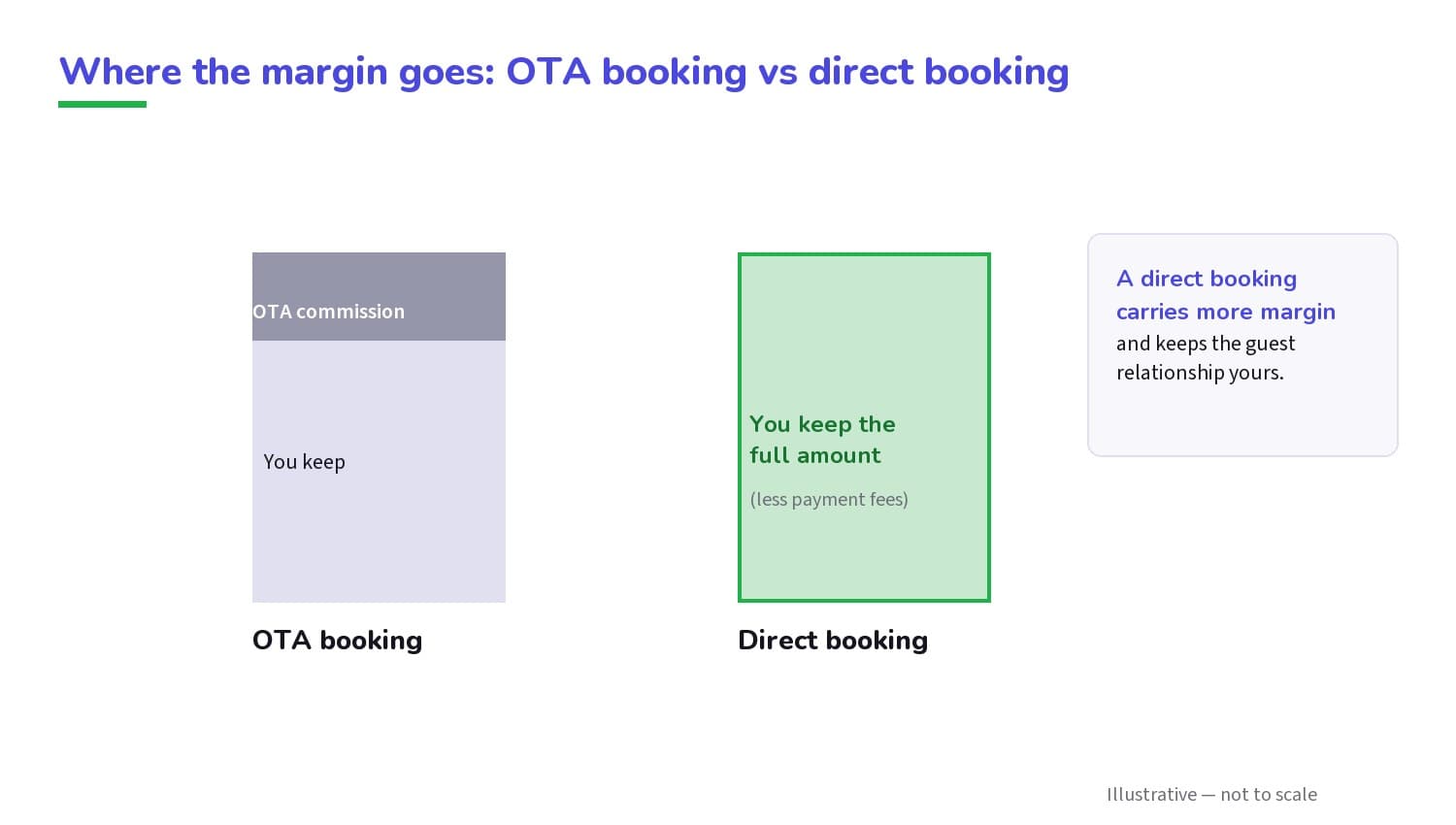
Start with the number that makes the whole conversation worth having. OTA commissions on vacation rentals commonly run in the mid-teens as a percentage of the booking, and the true cost is higher once you count cancellation exposure, ancillary fees, and paid-visibility programs on top of the headline rate. A direct booking carries none of that commission. The guest books on your channel, and you keep the full amount, less only standard payment processing.
At portfolio scale, this compounds into real money. If a meaningful share of your bookings moves from an OTA channel to a direct one, the margin difference is not a rounding error, it is often the difference between a thin operating margin and a healthy one. Direct bookings also tend to be higher value: guests who book direct often book longer stays and add extras, so the revenue per booking can be higher, not just the margin.
So the prize is real. The reason most operators do not capture it is not that they misunderstand the math. It is that the math is the easy part.
Why "go direct" stalls (the say-do gap)
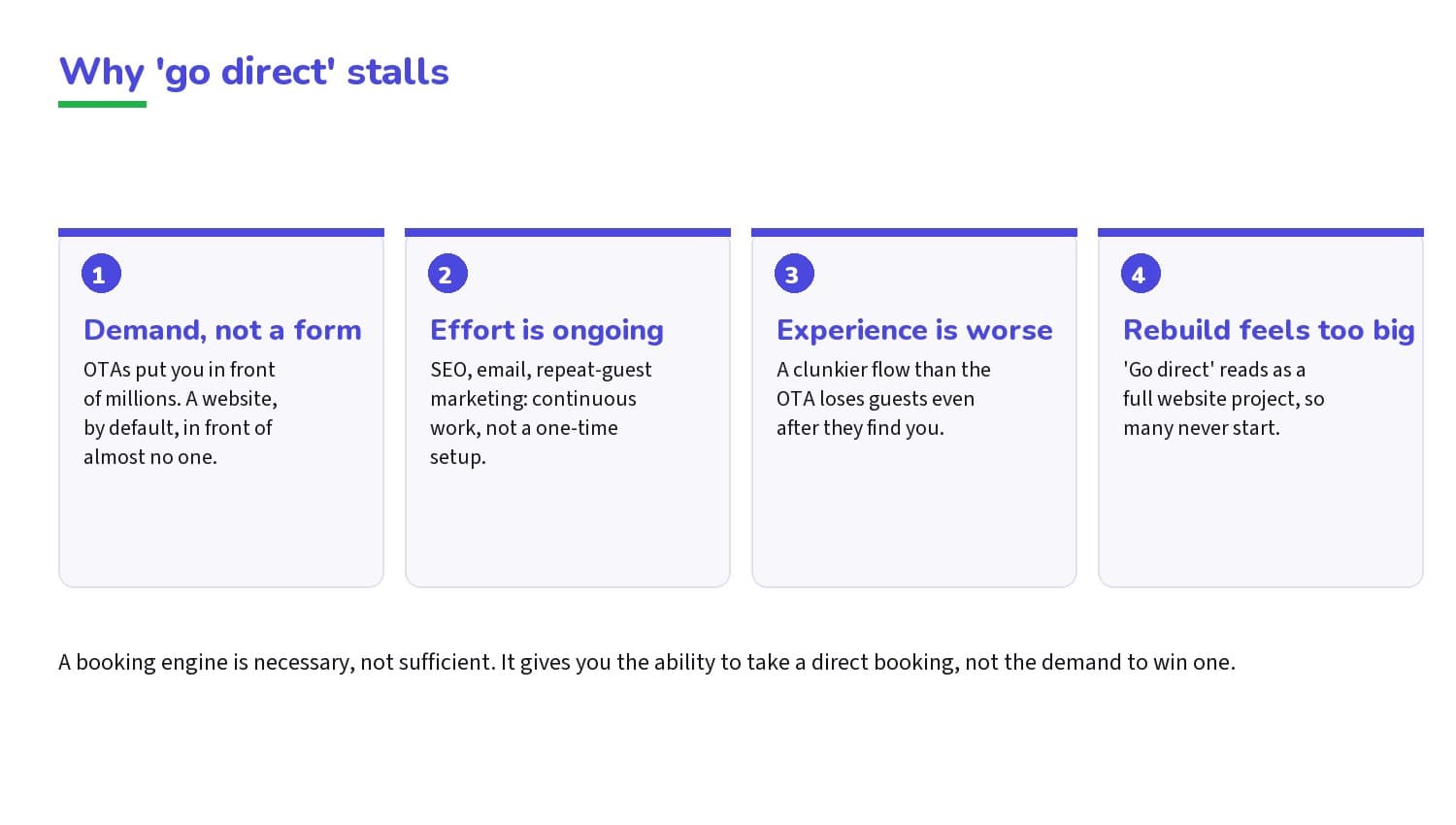
Here is the honest picture the booking-engine vendors rarely paint: operators say they want direct bookings, but the average direct share across the industry has plateaued for years, sitting well below OTA-driven bookings despite sustained investment in direct-booking tools. That gap between stated intent and actual result is the most important fact in this entire topic, and understanding it is what separates operators who succeed from those who buy a booking engine and see nothing change.
The direct channel stalls for reasons that a booking engine alone does not fix:
- OTAs supply demand; a website does not. An OTA puts your property in front of millions of active searchers. Your own website, by default, is seen by almost no one. Buying a booking engine gives you the ability to take a direct booking. It does not give you anyone to take it from.
- The effort is ongoing, not one-time. A direct channel needs demand generation behind it: SEO, an email list, repeat-guest marketing, social proof. That is continuous work, and most operators do not have the capacity for it, so the channel underperforms and gets written off.
- The booking experience is often worse than the OTA's. If your direct booking flow is clunkier than Airbnb's, guests abandon it even when they found you. A booking engine that is merely present is not enough; it has to be genuinely good.
- The website rebuild feels too big to start. Many operators associate "go direct" with a full website project they do not have time for, so they never start.
None of this means direct booking is not worth it. It means direct booking is a margin-and-relationship strategy that takes sustained effort, not a switch you flip by installing software. The operators who win are the ones who accept that and build for it.
The two things that actually move the direct share
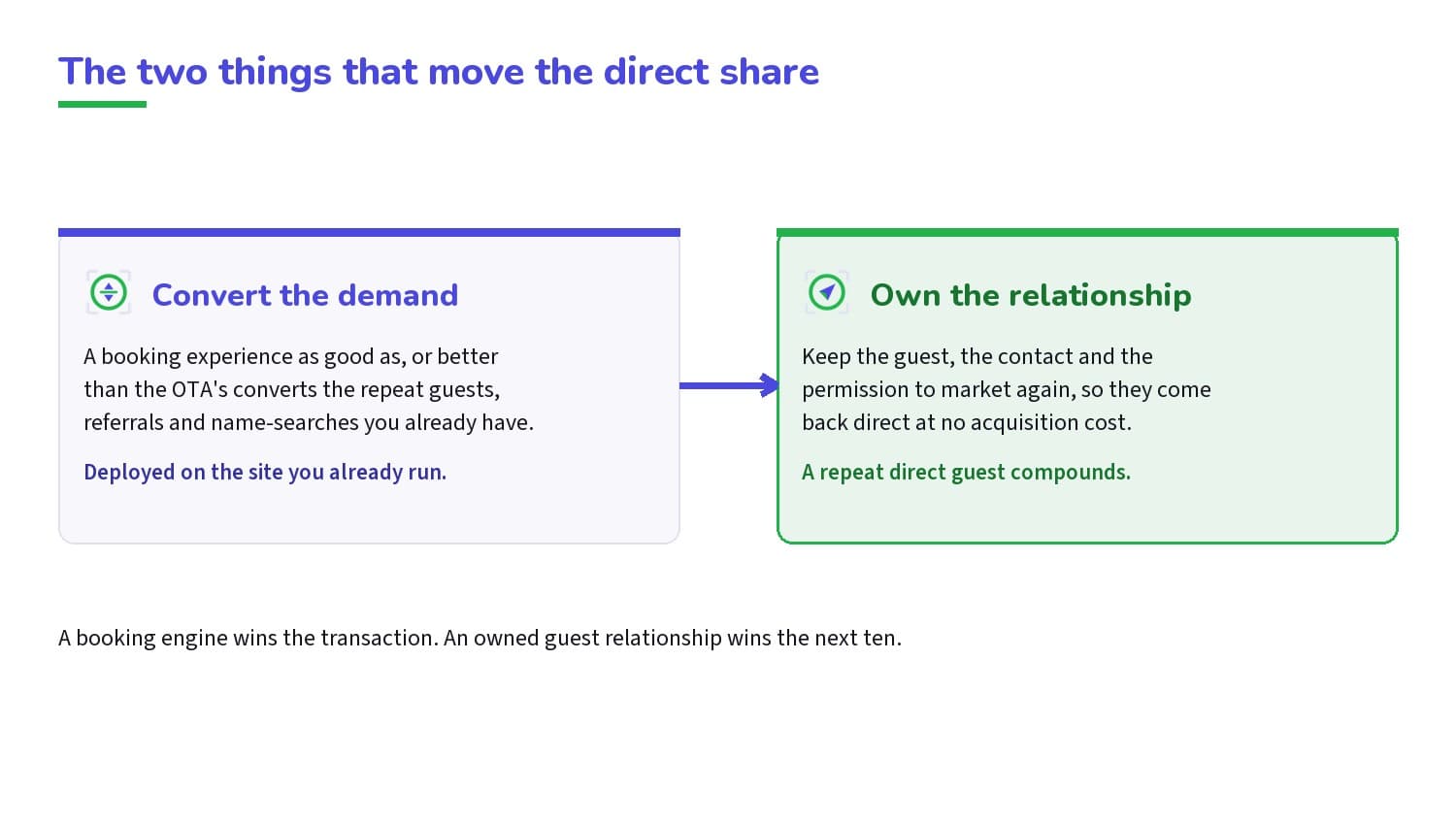
If a booking engine alone does not move the number, what does? Two things, and they reinforce each other.
1. A booking experience good enough to convert the demand you do have.
Most operators already have some direct demand: repeat guests, referrals, people who found them on an OTA and searched their name, local reputation. That demand leaks away when the booking experience is worse than the OTA's. The first lever is not more demand, it is converting the demand you already have, by making the direct booking flow as good as or better than the alternative. That means a booking flow you can shape to your properties and your guests, not a generic form, and it means letting guests book with confidence, for example by showing them the space properly before they commit rather than making them guess from photos.
2. Owning the guest relationship so you can bring them back.
The deepest value of a direct booking is not the single commission you save. It is that the guest is now yours: you have the relationship, the contact, the permission to market to them again. A repeat direct guest costs you nothing to acquire the second time. This is where direct booking becomes a compounding advantage rather than a one-off saving, and it depends on actually owning and serving the guest relationship, not just processing one transaction.
This is why Direct and guest experience belong in the same conversation. A booking engine wins the transaction. An owned guest relationship wins the next ten. VIRTUENXT Direct gives you a booking flow you control, deployed on the site you already have, with a 360 room view so guests book with confidence. VIRTUENXT Guide then serves that guest through the stay and keeps the relationship yours. Together they turn a single saved commission into a guest you can bring back at no acquisition cost.
A framework for deciding your direct-booking strategy
Run your situation through these questions before you invest, so you invest in the thing that actually moves the number.
1. What is my current direct share, and what is it worth to move it?
Calculate the margin difference between a direct and an OTA booking for your properties, then model what a 5 or 10 percentage-point shift in direct share is worth annually. That number tells you how much effort the channel justifies.
2. Do I have latent direct demand I am failing to convert?
Repeat guests, referrals, and name-searches are demand you already have. If your booking experience is worse than the OTA's, you are leaking this demand. Converting it is the fastest, cheapest win, and it comes before demand generation.
3. Is my booking experience actually competitive?
Compare your direct booking flow, honestly, to booking the same property on an OTA. If yours is slower, clunkier, or gives the guest less confidence, fix that before spending on demand.
4. Can I own and re-market to the guest relationship?
A direct booking is worth far more if it becomes a repeat guest. Do you capture the relationship and have a way to serve and re-engage the guest? If not, you are leaving most of the value on the table.
5. Do I have the capacity for the ongoing demand work?
Direct booking needs continuous effort behind it. Be honest about whether you have it. If not, prioritise converting existing demand and owning the guest relationship, which need less ongoing marketing than net-new demand generation.
Frequently asked questions
- How much commission do OTAs take on vacation rentals?
- OTA commissions on vacation rentals commonly run in the mid-teens as a percentage of the booking, and vary by platform, market, and fee model. The true cost is usually higher than the headline rate once you include cancellation exposure, ancillary fees, and paid-visibility or preferred-partner programs. A direct booking avoids the commission entirely, leaving only standard payment-processing fees, which is why direct bookings carry materially more margin per stay.
- What is the true cost of OTA bookings?
- Beyond the commission percentage, the true cost includes the guest relationship you do not own (you cannot easily re-market to an OTA guest), the pressure to join paid-visibility programs, cancellation and rate-parity constraints, and the fact that you are competing on the OTA's terms. Direct bookings recover the margin and the relationship, but require you to supply the demand and the booking experience the OTA otherwise provides.
- How do I get more direct bookings?
- Start by converting the direct demand you already have (repeat guests, referrals, name-searches) with a booking experience at least as good as the OTA's, then own the guest relationship so those guests come back direct, and only then invest in generating net-new demand (SEO, email, content). Buying a booking engine is necessary but not sufficient: the channel needs a good experience and ongoing demand work behind it to move the share.
- Why has my direct-booking share not grown even though I have a booking engine?
- Because a booking engine gives you the ability to take a direct booking but not the demand or the experience to win one. Industry direct share has plateaued for years despite investment, largely because operators install the tool but do not address the two things that actually move the number: a booking experience competitive with the OTA, and ownership of the guest relationship so guests return direct.
- Is it worth building a direct-booking channel?
- For most operators at portfolio scale, yes, because the margin difference is significant and repeat direct guests compound. But it is worth it only if you treat it as a margin-and-relationship strategy that needs sustained effort, not a website project you complete once. Model the margin gain, be honest about the effort, and prioritise converting existing demand and owning the guest relationship first.
Next steps
Direct booking is one of the largest margin levers available to a property manager, but only for operators who treat it as it really is: a strategy of converting the demand you have, making the booking experience genuinely good, and owning the guest relationship so guests come back at no acquisition cost. The booking engine is the starting point, not the strategy.
VIRTUENXT gives you the pieces that move the number. Direct is a booking engine and website that runs on the PMS you already use, with a booking flow you control and a 360 room view so guests book with confidence. Guide keeps the guest relationship yours through the stay, in the guest's own language. Both run on top of your existing PMS and keep your data portable.
See how it would work for your bookings. Request a demo.
VIRTUENXT is a suite of hospitality products engineered by JebiTech, a hospitality technology company building software for operators and the platforms they run on since 2017.
Related on VIRTUENXT