TL;DR
The real cost of a vacation rental tool is not its subscription. It is the integration project behind it: another connection to your PMS, another data mapping, another few weeks of setup and risk, repeated every time you add a tool. That hidden cost is why stacks get expensive and fragile as operators grow. The way to control it is to evaluate additions on total cost of adoption, and to prefer tools that share one connection and one copy of your data, so the expensive part is paid once instead of every time. VIRTUENXT is built this way: it runs on top of the PMS you already use, and every product in the suite draws on the same connection, so each product you add costs less to adopt than the one before it.
Premise
Every property manager reaches a point where the PMS is not enough and the question becomes: add tools on top, or move to an all-in-one that does everything? This guide gives you a decision framework for that choice, and shows the number most software comparisons never mention: what each new tool actually costs to connect and run, not just its monthly price. After reading it you will be able to evaluate any addition to your stack on total cost, not sticker cost.
The choice every growing operator faces
There is a predictable moment in the life of a property management company. You started on a PMS that handled the basics. The portfolio grew. Now the PMS does perhaps 90% of what you need, and the missing 10% is where the pain lives: owner settlements on a spreadsheet, guest questions on WhatsApp, inspections by drive-around, accounting re-keyed by hand every month.
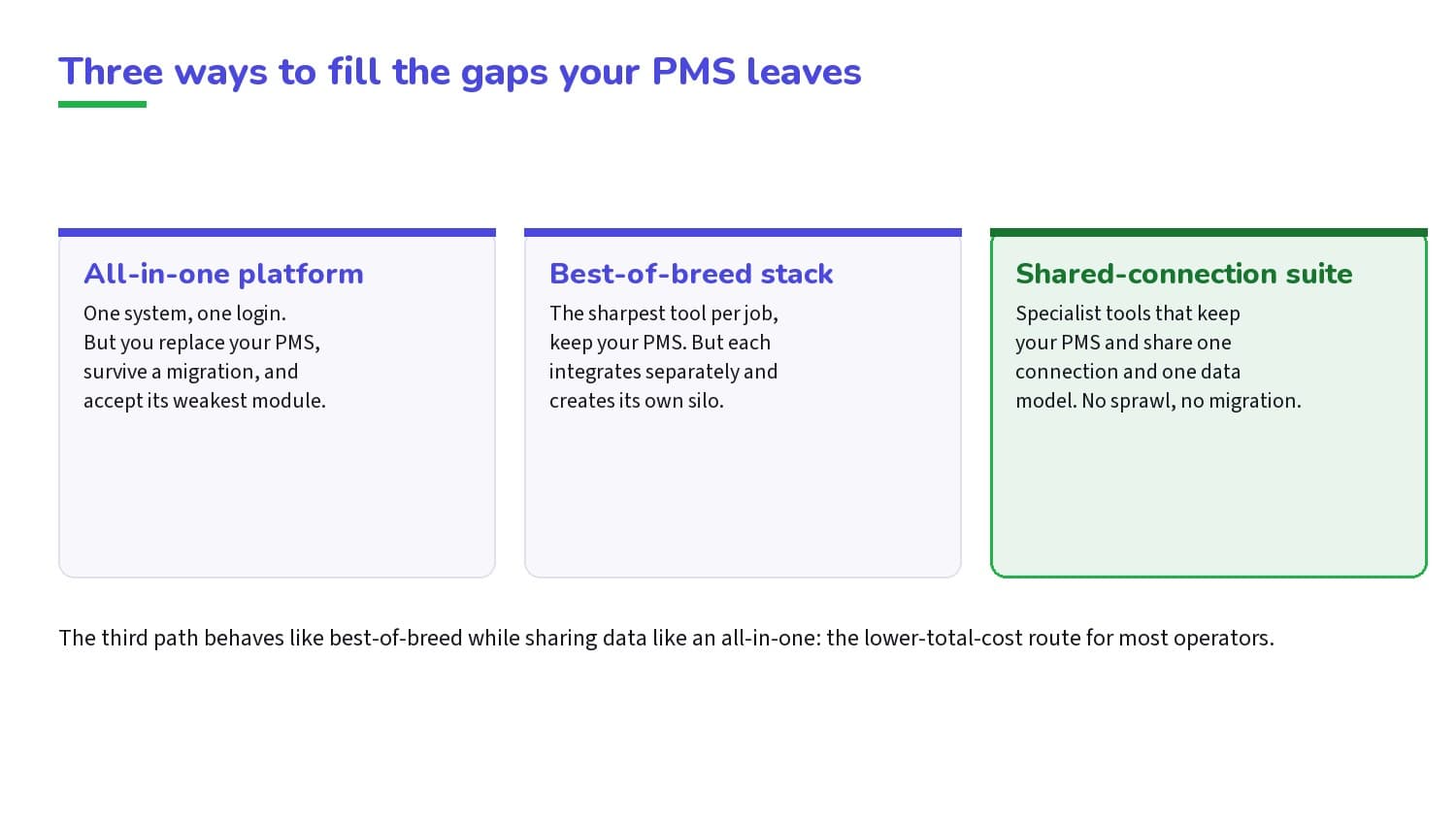
At that moment you face a fork. Add specialist tools on top of the PMS to fill the gaps (the best-of-breed path), or move to an all-in-one platform that promises to do everything in one system (the rip-and-replace path). Both are sold hard, and both have real trade-offs. The best-of-breed path gives you the sharpest tool for each job but risks a sprawl of disconnected systems. The all-in-one path promises tidiness but asks you to abandon the PMS you already run and survive a migration to get it.
Most comparisons stop there, at features and monthly prices. That is the wrong place to stop, because it misses the number that actually determines what your stack costs you: the cost of connecting each tool to your data.
The number nobody puts on the comparison sheet
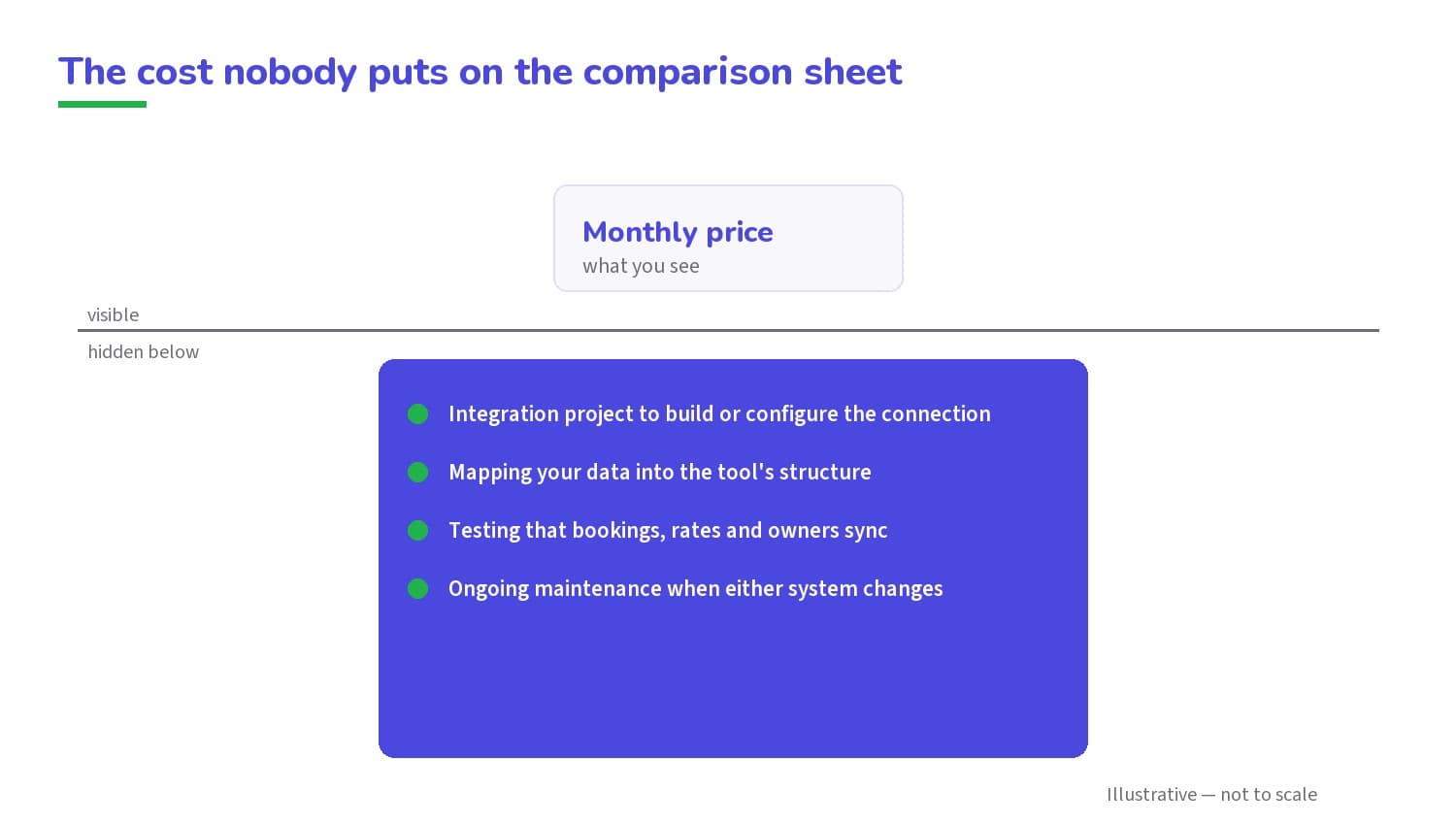
When you evaluate a new tool, you see its monthly price. What you do not see, and what rarely appears on any comparison sheet, is the integration cost behind it.
Every tool that connects separately to your PMS carries a setup project: an API connection to build or configure, your data mapped into that tool's structure, testing to make sure bookings and rates and owner records sync correctly, and the ongoing maintenance of that connection when either system changes. For one tool, that is a manageable project. The problem is what happens as you add more.
Each new best-of-breed tool that connects independently does three things that compound:
- It runs its own integration project. More setup time, more cost, more risk, every single time.
- It creates its own copy of your data, in its own format. Five tools can mean five silos, five slightly different versions of the truth, and five things to reconcile.
- It adds a connection that can break. When your PMS updates, or a tool changes its API, someone has to notice and fix it. More connections mean more fragility.
This is why an operator who has added tools one at a time over three years often ends up with a stack that is expensive to run, hard to report across, and brittle when anything changes. Not because any single tool was a bad choice, but because the integration cost of each was invisible at the point of decision.
A framework for evaluating any addition to your stack
Before you add a tool, or choose between the layered and all-in-one paths, run the decision through these questions. They surface the total cost, not the sticker cost.
1. What is the total cost of adoption, not the monthly price?
Add the setup project (time and money), the data-mapping effort, the testing, and the ongoing maintenance of the connection, to the subscription. That is the real cost. A cheaper tool with a heavy integration can cost more than a pricier one that connects cleanly.
2. Where will this tool's copy of my data live, and in what format?
If it creates its own silo in its own structure, you are adding to your fragmentation and your future switching cost. If it shares a connection and a common data model with tools you already run, you are not.
3. Can I report across this tool and the rest of my stack?
A tool that cannot share a data model with your others forces manual, cross-system reporting. If portfolio-wide reporting matters (and past 100 units it always does), this is a first-order question, not a detail.
4. What happens when I add the next tool?
Does the next addition start from scratch, or does it reuse the connection and data foundation this one built? This is the question that separates a stack that gets cheaper to extend from one that gets more expensive.
5. Does adopting this require touching my PMS?
An all-in-one that replaces your PMS asks you to justify a full migration before you get any value. A tool that runs on top of your existing PMS does not. Weigh the migration cost honestly: it is months of work and real operational risk.
6. If I leave this tool, does my data leave with me, clean and usable?
The same portability test that applies to your PMS applies to everything on top of it. A tool that traps your data is a future cost you are signing up for today.
Layered versus all-in-one: an honest comparison
Neither path is universally right. The framework above tells you which fits your situation. Here is the honest trade-off.
The all-in-one platform puts everything in one system, so there is one login, one data model, one vendor. That tidiness is real. The cost is equally real: to get it, you replace the PMS you already run and undertake a migration, and you accept whatever that single vendor's weakest module is, because you cannot swap just that one part. You trade flexibility and your existing system for consolidation.
The best-of-breed stack gives you the sharpest tool for each job and lets you keep the PMS that fits your market. The classic cost is fragmentation: each tool integrates separately, creates its own silo, and adds a connection to maintain. That is a genuine downside, and it is the reason all-in-one platforms win some operators over.
But the fragmentation cost is not a law of nature. It is a consequence of tools each connecting separately. The path that gets the best of both is a set of products that behave like best-of-breed (specialist, sharp, keep your PMS) while sharing one connection and one data model like an all-in-one. You get the specialist capability without the sprawl, and you keep your PMS without the migration.
That combination is what a suite built on a shared connection provides, and it is the reason "layer, don't rip and replace" is not just a slogan but the lower-total-cost path for most operators in the 20-to-500-unit range.
The compounding advantage: each product costs less than the last
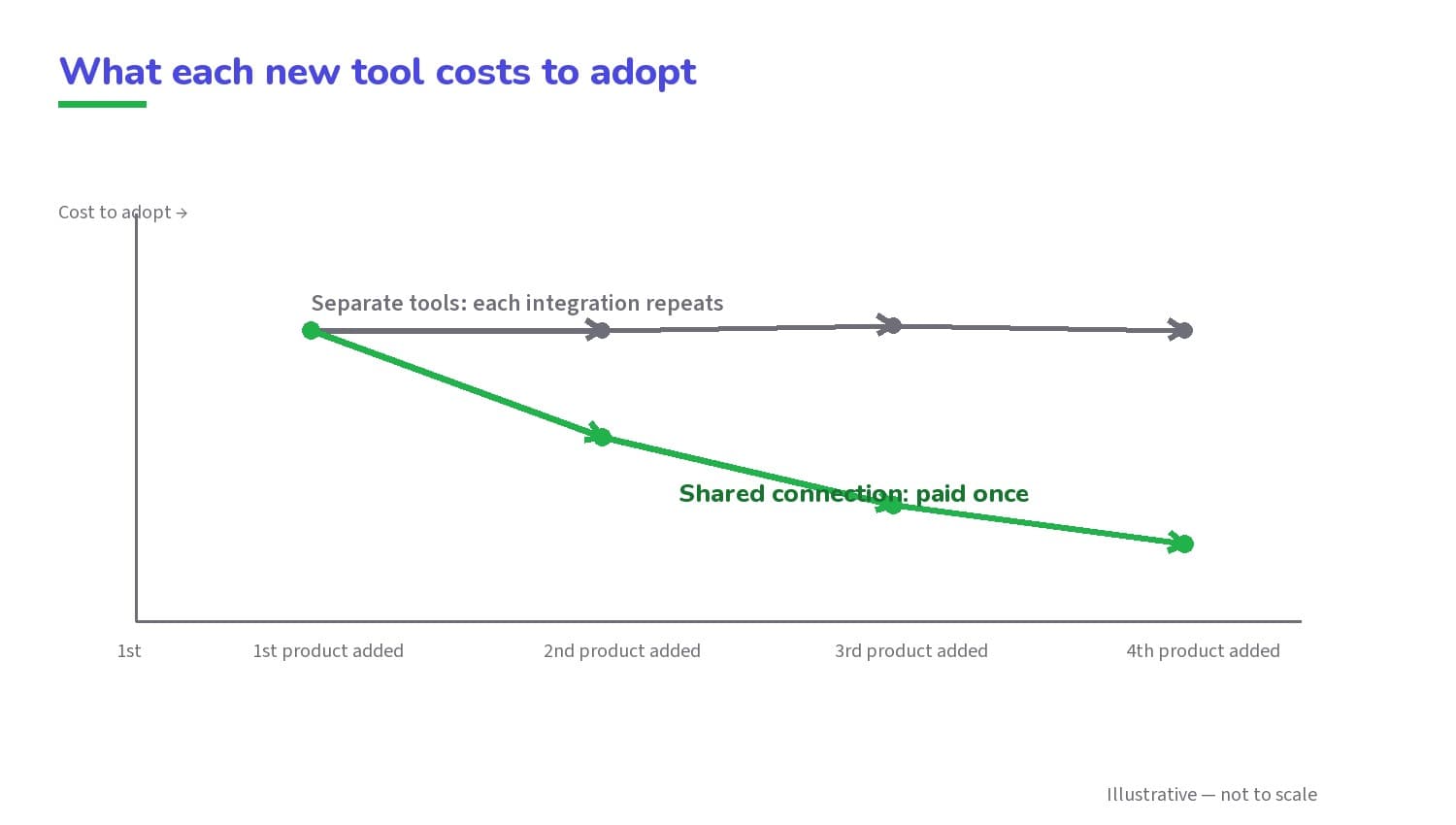
Here is the payoff of a shared connection, expressed as the number your budget holder cares about.
With most tools, every new product is a fresh integration project. With a suite that shares one connection to your PMS, that work happens once. The first product you add includes the connection to your PMS and a normalised copy of your data. The second product uses the same connection. So does the third and the fourth. The expensive, risky part, connecting to your stack and trusting the data, is already built and already paid for.
So the math inverts. In a fragmented stack, each tool you add is roughly as expensive to adopt as the last, because each runs its own integration. In a shared-connection suite, each product you add costs less to adopt than the one before it, because the hard part is done. That changes how you plan: you can start with the single product that solves your most acute pain, and add the next when the business is ready, not when it can afford another integration.
This is how VIRTUENXT is designed. Every product in the suite, whether that is AI inspection, a direct booking engine, guest experience, real-time owner settlement, hospitality accounting, or franchise oversight, runs on the same real-time connection to your PMS and draws on the same copy of your data. Start with one. Add the rest without a new integration project each time. And because the same connection keeps a portable copy of your data, you keep the freedom to change your PMS later without losing anything.
How to run the evaluation in practice
- Step 1: Map your current stack and its connections. List every tool that touches your operational data, and for each, note how it connects to your PMS and where it stores its copy of your data. Most operators have never seen this map, and it usually explains where the cost and fragility are.
- Step 2: Cost your next addition on total cost of adoption. For the next tool you are considering, estimate the setup, mapping, testing, and maintenance, not just the subscription. Compare that total to the alternative of a product that reuses a connection you already have.
- Step 3: Decide layered versus all-in-one on your real constraints. If your PMS genuinely fits and a migration is the main barrier, the layered path almost always wins. If your PMS itself is the problem, weigh a change, but apply the portability test so the next system does not trap you the way the last one did.
- Step 4: Prefer additions that reduce future cost. Between two tools that solve the same problem, the one that shares a connection and data model with your stack lowers the cost of everything you add after it. That is worth more over time than a small difference in monthly price.
- Step 5: Sequence by pain, not by vendor push. Add the product that solves your most acute, wallet-open problem first. Expand from there as the connection makes each next step cheaper.
Frequently asked questions
- What is a vacation rental tech stack?
- A vacation rental tech stack is the set of software tools an operator uses to run the business, typically built around a core PMS (the system of record) plus specialist tools for the jobs the PMS does not do well: pricing, guest communication, inspections, owner settlement, accounting, and more. The important thing about a stack is not just which tools are in it, but how they connect and whether they share your data or fragment it.
- Should I use an all-in-one PMS or separate best-of-breed tools?
- It depends on your real constraint. If your PMS fits your market and the main barrier is the cost and risk of migrating, adding specialist tools on top (best-of-breed) is usually the lower-total-cost path. If your PMS itself is the problem, an all-in-one may be worth the migration, but evaluate whether it traps your data. The best outcome combines both: specialist tools that share one connection and one data model, so you avoid fragmentation without a migration.
- How much does it cost to add a tool to my stack?
- More than the subscription. The full cost includes the integration project (building or configuring the connection to your PMS), mapping your data into the tool, testing the sync, and maintaining the connection over time. This hidden integration cost is often larger than the monthly price and is the main reason stacks get expensive as they grow. Tools that reuse a connection you already have avoid most of it.
- When do I outgrow my PMS?
- Usually when the manual workarounds for the things your PMS does not do (spreadsheet settlements, WhatsApp guest handling, manual cross-property reporting) start costing more time and error than they save. That is the point to add capability. It is not automatically the point to replace the PMS, adding the missing capability on top is often the cheaper and lower-risk answer.
- Does adding tools on top of my PMS create data silos?
- It can, if each tool connects separately and stores its own copy of your data in its own format. That is the classic fragmentation cost of a best-of-breed stack. It is avoidable: tools that share one connection to your PMS and one normalised data model give you specialist capability without the silos.
Next steps
The right question when your PMS is not enough is not "add tools or replace everything?" It is "how do I add capability without paying the integration cost every time, and without a migration I do not need?" Evaluate on total cost of adoption, prefer tools that share a connection and your data, and the math starts working for you instead of against you.
VIRTUENXT is a suite of hospitality products designed for exactly this. It runs on top of the PMS you already use, and every product draws on one shared connection and one copy of your data, so each product you add costs less to adopt than the last, and your data stays portable the whole time.
See how it would work on your stack. Request a demo.
VIRTUENXT is a suite of hospitality products engineered by JebiTech, a hospitality technology company building software for operators and the platforms they run on since 2017.
Related on VIRTUENXT