TL;DR
Owner churn is usually a trust problem before it is a performance problem. Owners who cannot understand how their payout was calculated, who get statements late, or who have to phone and ask “where's my money” start looking for a manager who makes them feel in control. The fix is transparency built into the settlement process: payouts calculated consistently and on time, statements owners can read without calling, and a self-service window so owners answer their own questions. Settlement run on a spreadsheet cannot deliver this at scale. A system that calculates owner splits in real time and gives every owner their own portal can. VIRTUENXT's approach (real-time settlement plus an owner portal, backed by hospitality accounting) is built to make transparency the default, not an extra step.
Premise
Owners leave property managers over money they cannot see clearly, more often than over money itself. This guide explains why settlement transparency is a retention lever, not a back-office chore, and gives you a practical playbook for turning statements, payouts, and owner questions from a monthly source of friction into a reason owners stay. After reading it you will be able to diagnose where your owner relationships are quietly at risk and fix the cause.
Why owners actually leave
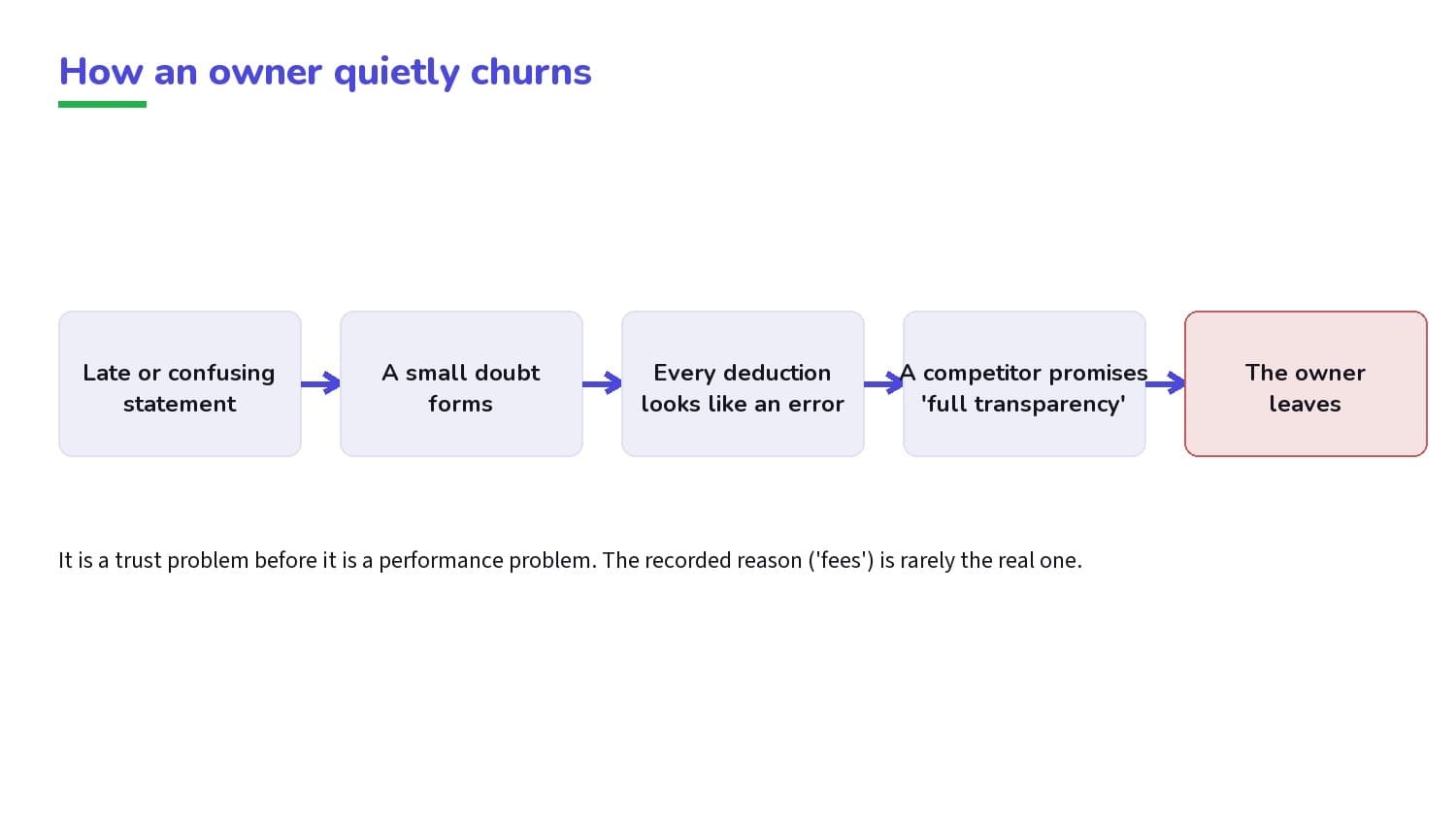
When an owner moves their property to another manager, the reason recorded is often "fees" or "performance." The reason underneath is frequently something quieter: they stopped trusting the numbers.
Think about the owner's experience of your business. They handed you their most valuable asset. Every month, money moves, expenses are deducted, and a payout lands, or does not. If they cannot see clearly how that payout was reached, if the statement is confusing, late, or different every month, a small doubt forms. That doubt is corrosive. It turns every deduction into a suspected error and every delay into a suspected problem. Eventually a competitor calls, promises "full transparency," and the owner leaves, not because your fees were high, but because theirs felt clearer.
This matters commercially because owner acquisition is expensive and owner retention compounds. A manager who keeps owners for years builds a stable, growing base. A manager who loses owners quietly, one confusing statement at a time, spends to replace them and never builds momentum. Retention is not a soft metric here. It is the difference between a business that scales and one that leaks.
The trust gap is built into how most settlements are run
Here is the uncomfortable part: for most property managers, the settlement process is structurally incapable of delivering the transparency owners want. Not because the manager is careless, but because of how settlement is done.
The typical setup looks like this. Owner splits live in a spreadsheet that one person truly understands. Each month, someone pulls reservation data, applies the splits by hand, deducts expenses and utilities, and produces statements. It works, until it does not scale, and the cracks are exactly where owner trust breaks:
- Splits are inconsistent. A formula applied by hand varies. Different owners, different channels, and edge cases get handled slightly differently each month, and owners compare notes.
- Charges get missed or misapplied. A utility bill allocated to the wrong owner, or forgotten and added late, reads to the owner as either an error or a hidden fee.
- Statements go out late. Manual close takes longer as the portfolio grows, so statements slip, and a late statement is the single most common trigger for an owner to start asking questions.
- Owners cannot self-serve. Every "can you resend my statement?" and "how was this calculated?" becomes a phone call to your team, which is both a support cost and a trust signal: the owner feels kept in the dark.
- A change of owner breaks the formula. When a unit changes hands, a spreadsheet formula tied to the old arrangement quietly breaks, and the error surfaces as a wrong payout.
None of these is a character flaw. They are the natural failure modes of running settlement manually at scale. The transparency owners want is not something you can add on top of a spreadsheet. It has to be built into how settlement is calculated and shared.
The four pillars of owner-retention transparency
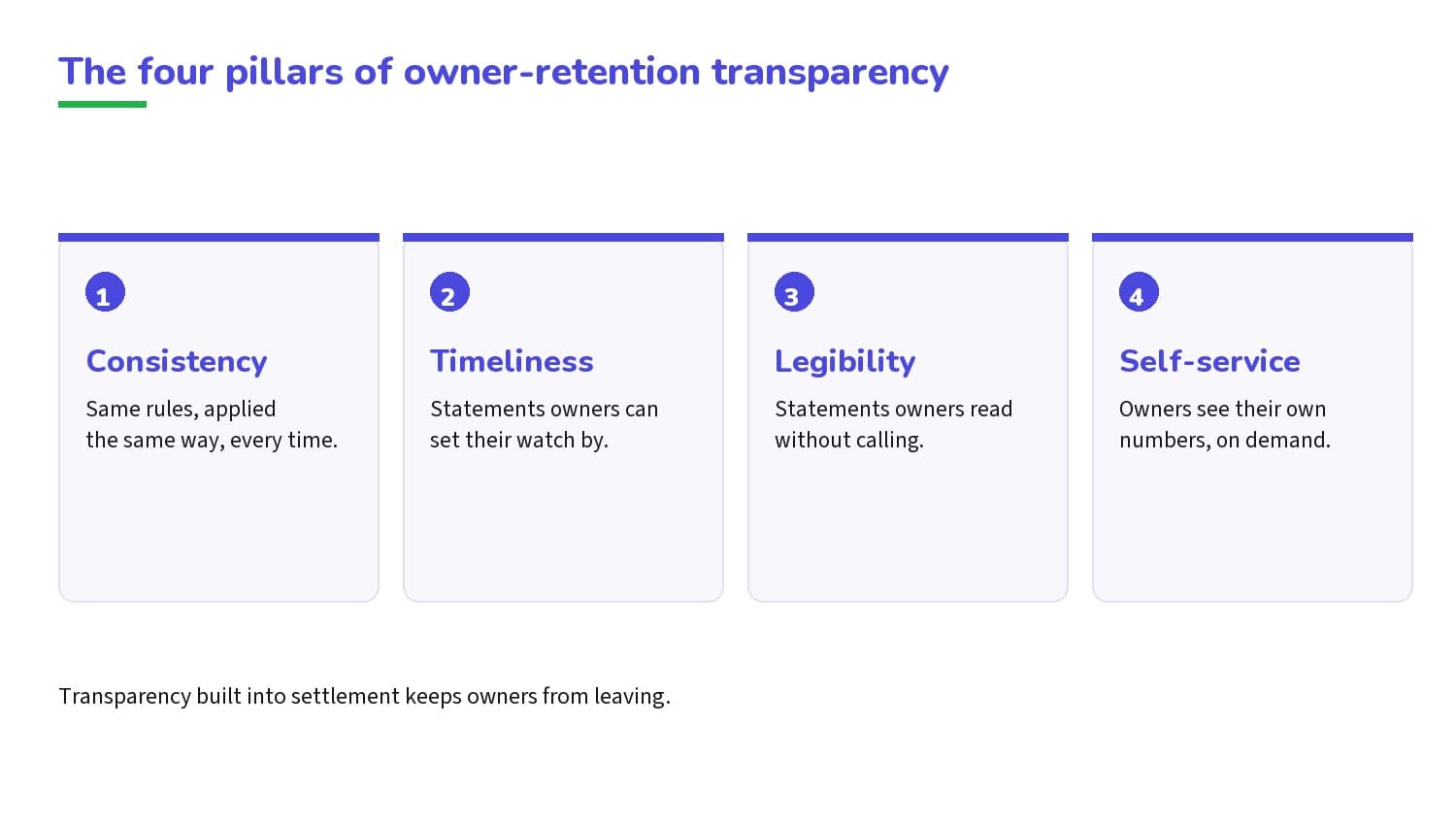
Transparency that actually retains owners rests on four things. Use these to diagnose your own operation.
1. Consistency: the same rules, applied the same way, every time.
Owners forgive a fee they understand and expect. They do not forgive a number that changes for reasons they cannot see. Splits and deductions have to be applied by a consistent rule, not a monthly manual calculation, so an owner can predict their payout and trust it when it arrives.
2. Timeliness: statements owners can set their watch by.
A statement that arrives on the same day every month, reliably, is a trust signal in itself. Late statements create anxiety even when the numbers are right. Timeliness depends on not having a manual close that stretches as you grow.
3. Legibility: statements an owner can read without calling.
A good owner statement shows revenue, the split, expenses, utilities, retentions, and net payable, clearly enough that the owner understands it without picking up the phone. Legibility turns the statement from a source of questions into an answer.
4. Self-service: an owner window into their own numbers.
The strongest transparency lever is giving owners their own secure view: their properties, their statements, their payout history, and a way to approve or query charges themselves. Self-service does two things at once. It removes the "where's my money" support load from your team, and it makes the owner feel in control, which is the opposite of the feeling that makes them leave.
From spreadsheet to system: what changes
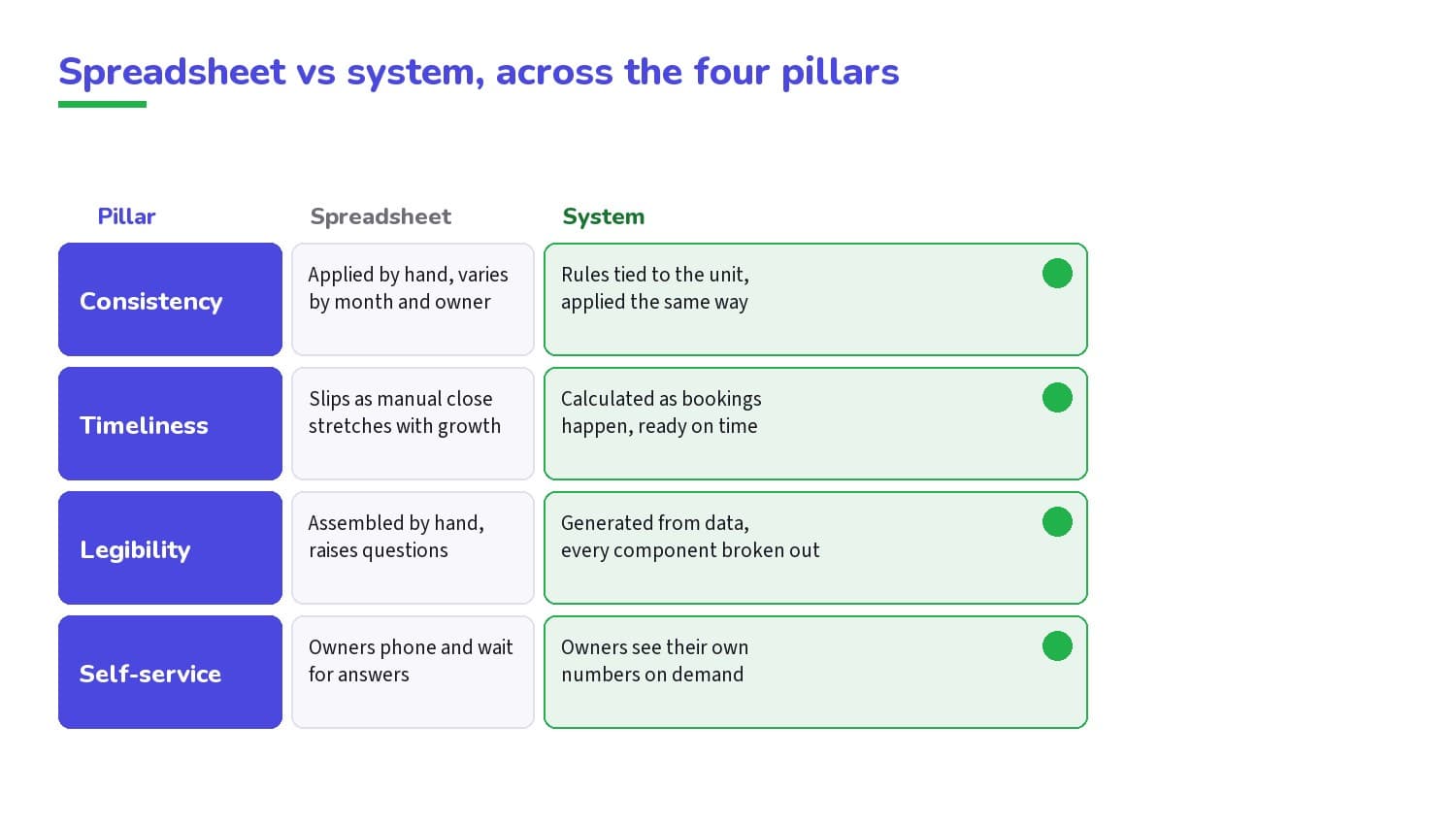
Moving settlement off a spreadsheet and into a system that is built for it changes each of the four pillars.
Consistency becomes automatic, because splits are defined as rules tied to the unit rather than recalculated by hand each month. A change of owner does not break the rule, because the rule is attached to the unit, not the arrangement. Different terms for different channels (an OTA booking, a direct booking, a corporate booking) can live inside one rule instead of being handled as monthly exceptions.
Timeliness stops depending on manual close, because the calculation happens as bookings happen, in real time, rather than in a month-end scramble. The statement is a report on numbers that are already current, not the output of a multi-day reconciliation.
Legibility improves because the statement is generated from structured data with every component broken out, revenue, split, expenses, utilities, retentions, net payable, rather than assembled by hand.
Self-service becomes possible because owners get their own secure login: they see only their own properties, download their own statements, review their payout history, and approve or reject charges themselves, with the full history kept in one place.
This is the design behind VIRTUENXT Settle. It calculates the owner and manager share in real time, at the moment of booking, using formulas tied to the unit and able to handle channel-specific terms inside a single rule. Owners get their own portal with statements, payout history, and an approve or reject workflow. The point is not the features, it is what they produce: transparency as the default state of the relationship, not an extra effort your team has to make every month.
Where accounting fits: the same numbers, all the way through
Settlement transparency has a second half that owners never see directly but feel constantly: whether the numbers reconcile cleanly to your books.
When settlement lives in a spreadsheet and accounting lives in generic software that has no concept of a reservation, an owner split, or a trust liability, the two are stitched together by hand. That re-keying is where errors enter, and a settlement error that traces back to a bookkeeping mismatch is exactly the kind of problem that erodes owner trust when it surfaces months later.
Hospitality-specific accounting closes that gap. When your accounting reads directly from the same PMS data your settlements are built on, the numbers owners see and the numbers in your books come from one source. Trust accounting, the legal obligation to handle owner and guest funds correctly, is handled natively rather than tracked in a side spreadsheet. VIRTUENXT Ledger does this: it turns PMS data into journals, a real-time trial balance, and financial statements, with trust accounting handled natively, and it complements the accounting tools you already run (QuickBooks, Xero) rather than replacing them. The owner-facing benefit is simple: the numbers are the same everywhere, so there is nothing for a dispute to catch on.
The retention playbook: five moves
- Move 1: Audit your current owner experience. Look at your last month of statements as an owner would. Were they on time? Could an owner understand them without calling? How many "where's my money" calls did your team field? The volume of those calls is your trust-gap gauge.
- Move 2: Make consistency structural, not manual. Define owner splits as rules, ideally tied to the unit so they survive an owner change, rather than as a monthly hand calculation. Consistency is the foundation the other pillars sit on.
- Move 3: Fix timeliness at the source. If statements slip because month-end close stretches, the answer is to stop depending on a manual close. Real-time calculation means the statement is ready when the period ends, not days later.
- Move 4: Give owners their own window. A self-service owner portal is the highest-impact retention move available, because it improves the owner's sense of control and removes support load at the same time. Prioritise it.
- Move 5: Reconcile owner numbers to your books automatically. Close the gap between settlement and accounting so the numbers owners see match your financials from one source. This prevents the slow-burning disputes that surface later.
Run these five and owner transparency stops being a monthly effort your team scrambles to deliver, and becomes a property of your operation that owners can feel. That is what keeps them.
Frequently asked questions
- How do property managers pay owners?
- Property managers calculate each owner's share of rental revenue, deduct agreed expenses, fees, and utilities, and pay out the net amount, usually monthly. The calculation is defined by the management agreement (the split, the fees, which costs pass through). The two things that determine whether owners trust the process are consistency (the rules applied the same way every time) and transparency (the owner can see how the number was reached). Manual, spreadsheet-based settlement struggles with both at scale.
- Why do owners leave property managers?
- Owners most often leave over trust rather than raw performance: confusing or late statements, payouts they cannot understand, hidden or inconsistent charges, and having to chase the manager for answers. A competitor who makes fees and payouts feel clearer can win an owner even without lower fees. Settlement transparency (consistent rules, timely legible statements, and owner self-service) is therefore a direct retention lever.
- What should an owner statement include?
- A clear owner statement shows the reservation revenue for the period, the owner and manager split, itemised expenses and utilities, any retentions, and the net amount payable, laid out so the owner can understand it without calling. Legibility matters as much as accuracy: a statement that raises questions creates support load and erodes trust even when the numbers are correct.
- How do I keep vacation rental owners happy?
- Beyond performance, owners stay when they feel in control of, and clear about, their money. The practical levers are: apply splits and deductions consistently, deliver statements on time, make statements easy to read, and give owners a self-service portal to see their own properties, statements, and payout history. Transparency built into the settlement process retains owners more reliably than any single perk.
- Can settlement be calculated in real time instead of at month-end?
- Yes. Rather than reconciling everything in a month-end scramble, settlement can be calculated as bookings happen, with the owner and manager share determined at the moment of booking using rules tied to the unit. Real-time calculation makes statements timely by default and removes the manual close that causes most late statements. This is how VIRTUENXT Settle is built.
Next steps
Owner retention is won or lost in the settlement process, in whether owners can see, understand, and trust how their money is handled. Fix consistency, timeliness, legibility, and self-service, and reconcile the numbers cleanly to your books, and you turn the monthly statement from a source of friction into a reason owners stay.
VIRTUENXT gives you the two pieces this needs. Settle calculates owner payouts in real time and gives every owner their own portal with statements and an approve or reject workflow. Ledger handles hospitality accounting and trust accounting from the same PMS data, so the numbers reconcile from one source. Both run on top of the PMS you already use, and keep your data portable.
See how it would work for your owners. Request a demo.
VIRTUENXT is a suite of hospitality products engineered by JebiTech, a hospitality technology company building software for operators and the platforms they run on since 2017.
Related on VIRTUENXT